

Interpolated Standard K
Interpolated Standard K fittings are dynamically generated within the Fitting Database when fittings that correspond to the current Pipe’s nominal size do not exist within the Fitting Database.
To generate a set of interpolated fittings, the software first selects a reference fitting size: the fitting nominal closest to the required pipe nominal (and typically the one offering the broadest set of fitting types). The K value of each fitting type for the reference fitting nominal size is then scaled using a turbulent-flow friction factor relationship.
The friction factor term, ft is calculated using a simplified Colebrook-White equation:
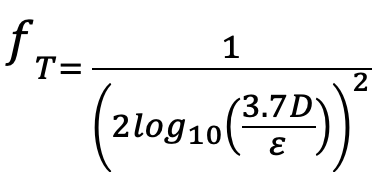
Where:
ft = Friction Factor
D = Nominal Diameter (in mm)
ε = Internal Roughness (A fixed roughness of 0.046 mm, typical of Steel Schedule 40, is used)
The software calculates
ft,req using the required nominal diameter, and
ft,ref using the reference fitting nominal diameter
The interpolated K value (Kinterp) is then obtained by scaling the reference fitting’s K value (Kf) in proportion to the change in ft:
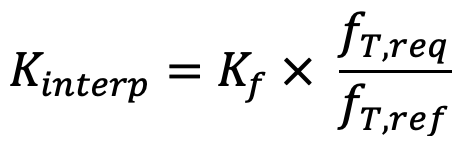
Where:
Kinterp = Interpolated K Value
Kf = Reference Fitting K Value
ft,req = Friction Factor for the required nominal diameter
ft,ref = Friction Factor for the reference nominal diameter
This method provides a consistent way to estimate Standard K values for intermediate or missing nominal sizes while remaining aligned with established turbulent-flow friction factor behavior.