

Hooper 2K
Hooper 2K fittings use a two-constant model designed to represent how the loss coefficient (K) varies with Reynolds number and fitting size. Instead of assuming a single fixed K value, the Hooper method combines a Reynolds-number-dependent component with a turbulent-flow component, allowing fitting losses to be represented over a wide range of flow conditions.
K1 – The Low-Reynolds-Number Constant: controls the Reynolds-number-dependent component of the fitting loss. The term K1/Re becomes increasingly important as Reynolds number decreases and therefore represents the increase in fitting K-value associated with laminar and low-Reynolds-number flow.
K∞ – The Turbulent-Flow Constant: represents the fully turbulent loss coefficient for the fitting. The actual high-Reynolds-number K-value also depends on fitting diameter and approaches K∞ as the fitting diameter becomes large.
The K-value is calculated from the two fitting constants together with the fitting diameter and fluid Reynolds number:
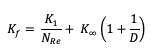
Where:
Kf = K value fitting loss coefficient (for use on the upstream pipe).
K1 = The laminar-flow constant for the fitting.
NRe = Reynolds number.
K∞ = The fully turbulent loss coefficient for the fitting.
D = Internal pipe diameter in inches.
Equation as defined in Darby, R., "Chemical Engineering Fluid Mechanics," 3rd Edition, 2017