

Expansion K
Expansion fittings are used to model sudden or gradual increase in pipe diameter. The loss coefficient (K) for an expansion depends on the flow characteristics, the change in pipe size, and the geometry of the expansion. For these fittings, the K value is calculated automatically based on:
Reynolds Number, accounts for the effect of flow regime on the expansion loss, particularly the difference between low-Reynolds-number and turbulent-flow behaviour.
The current pipe (D1) and follow-on pipe (D2) diameters, define the change in flow area and therefore the magnitude of the expansion.
(theta), the expansion angle, defines how abruptly the pipe diameter increases.
Sudden Expansions
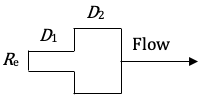

Where:
k = Sudden expansion loss coefficient K value (for use with velocity on the upstream pipe).
D1 = Internal diameter of the upstream (smaller) pipe.
D2 = Internal diameter of the downstream (larger) pipe.
Re = The Reynolds number.
f1 = Friction factor for the upstream pipe.
θ = Expansion angle (180o)
Gradual Expansions
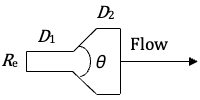
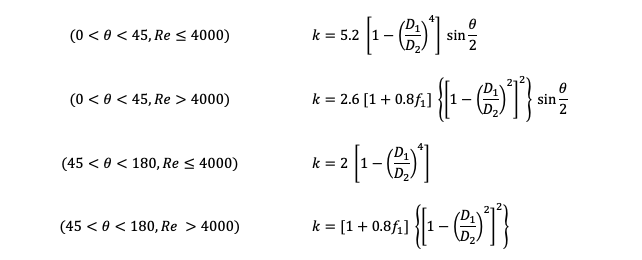
Where:
k = Gradual expansion loss coefficient K value (for use on the upstream pipe).
D1 = Internal diameter of the upstream (smaller) pipe.
D2 = Internal diameter of the downstream (larger) pipe.
Re = The Reynolds number.
f1 = Friction factor for the upstream pipe.
θ = Total included expansion angle of the conical section (in degrees)