

Case 21: Air Pressure Drop in Steel Pipe
Reference: Piping Calculations Manual, 2005, McGraw-Hill, E. Shashi Menon, Chapter 5, page 265 Example 5.8
Pipe Flow Expert File: Case_21_Air_Flow_Pressure_Drop.pfe
Problem Description:
Air flows at 50 ft/s in a 2” inside diameter pipe at 80°F, at an initial pressure of 100 psi.g.
If the pipe is horizontal and 1000 ft long, calculate the pressure drop if the flow is isothermal.
Use a friction factor of 0.02.
The calculation method used for the published data was the General Isothermal Flow Equation.
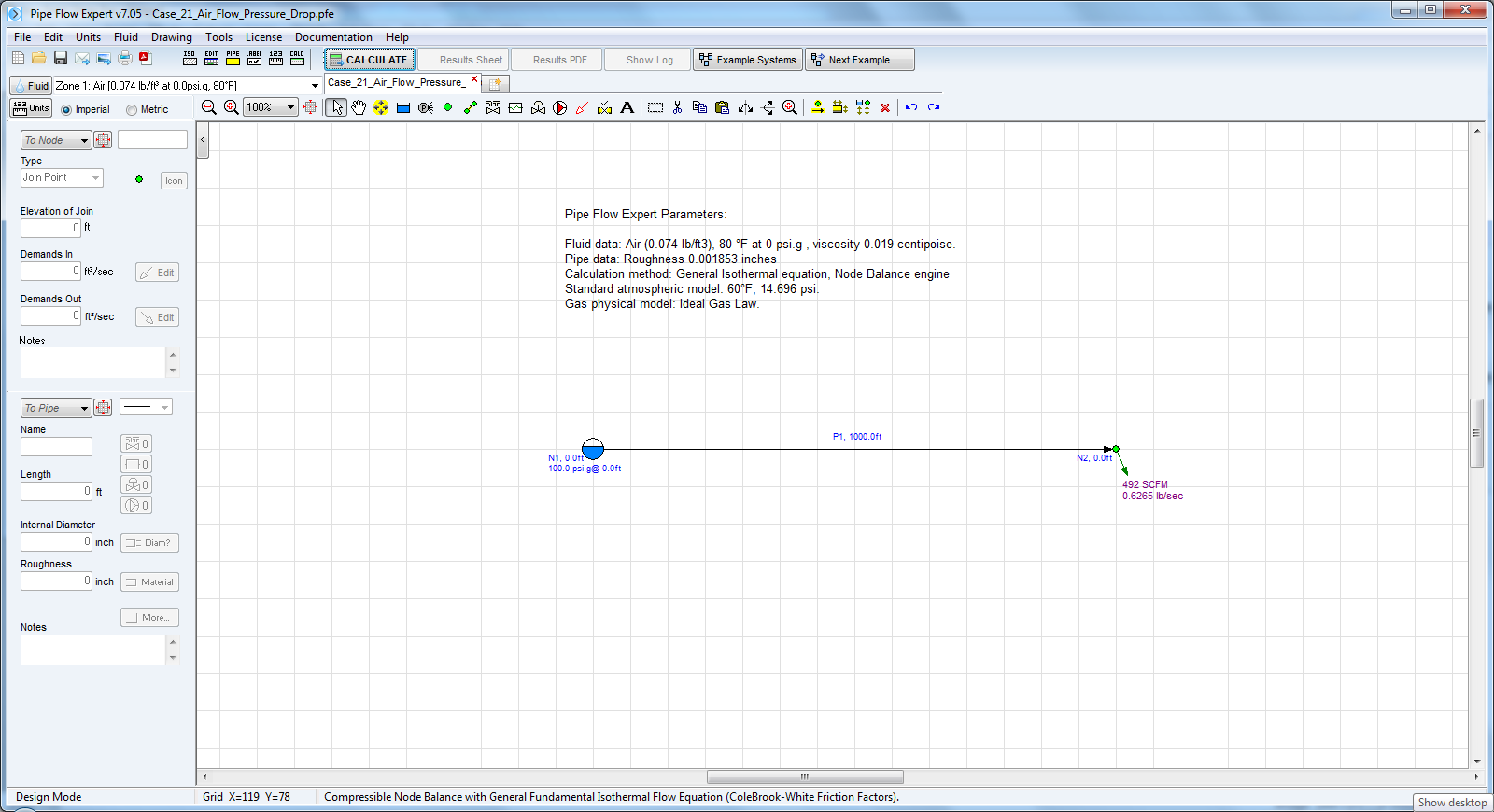
Pipe Flow Expert Parameters:
Fluid Data: Air at 80 °F, 0.0 bar.g, density 0.0736 lb/ft3, viscosity 0.0185 centipoise
Pipe Flow Expert will automatically calculate for compression of the gas to the 100 psi.g condition.
The fluid data must however be defined at the required temperature.
Pipe Data: Roughness 0.001853 inches (pipe material Steel (ANSI) schedule 40).
Calculation Method: General Isothermal Flow equation, Node Adjust Method.
Standard Atmospheric Model: 60°F, 14.696 psi.a
Gas Physical Model: Ideal gas Law.
Result Comparison:
|
Data Item |
Published data |
Pipe Flow Expert |
|
Outlet Pressure (psi.a) |
94.18 |
94.1784 |
|
Pressure drop (psi) |
20.52 |
20.5166 |
Commentary:
The published data and the calculated results compare well.
The normal pipe roughness for mild steel pipe is 0.001811 inches, however this was adjusted to 0.001853 inches to give a friction factor of 0.02 as assumed in the published text.
Although the fluid data is defined for 80°F and 0.0 bar.g, Pipe Flow Expert’s compressible flow engine automatically accounts for and calculates for compression of the air down to the 100 psi.g starting condition.